
Building the Drug Discovery Engine of the Future with AI-Empowered Nodal Biology
“Inspired by the visionary predictions of Jules Verne, this essay by Anna Greka proposes that integrating artificial intelligence with a paradigm called “nodal biology” will revolutionize the discovery of treatments and cures. Current drug development is slow, costly, and failure-prone, constrained by the challenge of drug target identification. Solving the “cell perturbation prediction problem”—predicting how human cells respond to any disease-causing perturbation—is key to accelerating successful drug target identification. Nodal biology, the discovery of shared druggable mechanisms (nodes) among seemingly disparate diseases, offers a scalable approach to generate the high-quality data needed to train cell prediction AI models. As an example, a cargo receptor node was identified, linking dozens of genetic diseases and leading to a new drug candidate. The synergistic combination of human scientific intuition and AI-empowered nodal biology is essential for building the biomedical innovation engine of the future, ultimately accelerating treatments for all human diseases.”
Redefining What's Possible with Gene Editing and ASO Therapies
“We are in the golden age of science and technology, advancements in gene editing and ASO therapies are allowing doctors to deliver targeted, and in some cases one-time, interventions for conditions once considered untreatable. A conversation with Harvard Medical School Professor Dr. Anna Greka and n-Lorem Foundation Chairman & CEO Dr. Stan Crooke about what this means for millions of patients now and in the future.”
Watch the conversation from the CNBC Cures Summit here.
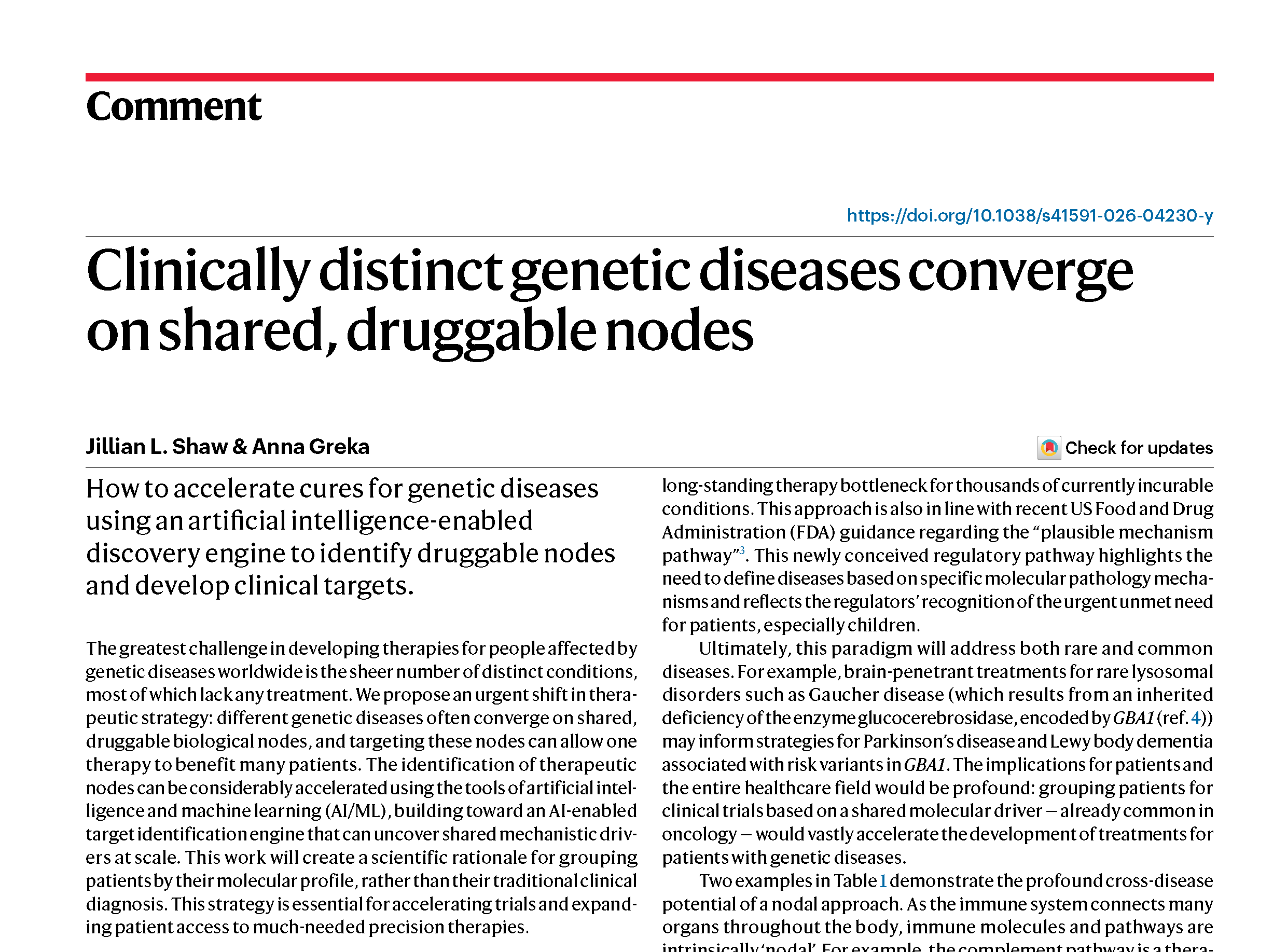
A roadmap for finding druggable nodes
In a comment in Nature Medicine, Jillian Shaw and Anna Greka describe a framework for identifying druggable “nodes” shared by clinically distinct genetic diseases in an effort to accelerate the development of treatments that target these nodes. In this Comment, the team lays out a three-step method for discovering these targets: (1) build cellular models of thousands of disease-causing genetic variants in a pooled fashion; (2) conduct massively parallel perturbation screens using single-cell and high-content readouts to find shared mechanisms underlying thousands of mutations; (3) use these datasets to train AI models to predict druggable nodes. These insights may lead to the grouping of patients according to their molecular profiles rather than their traditional diagnoses.
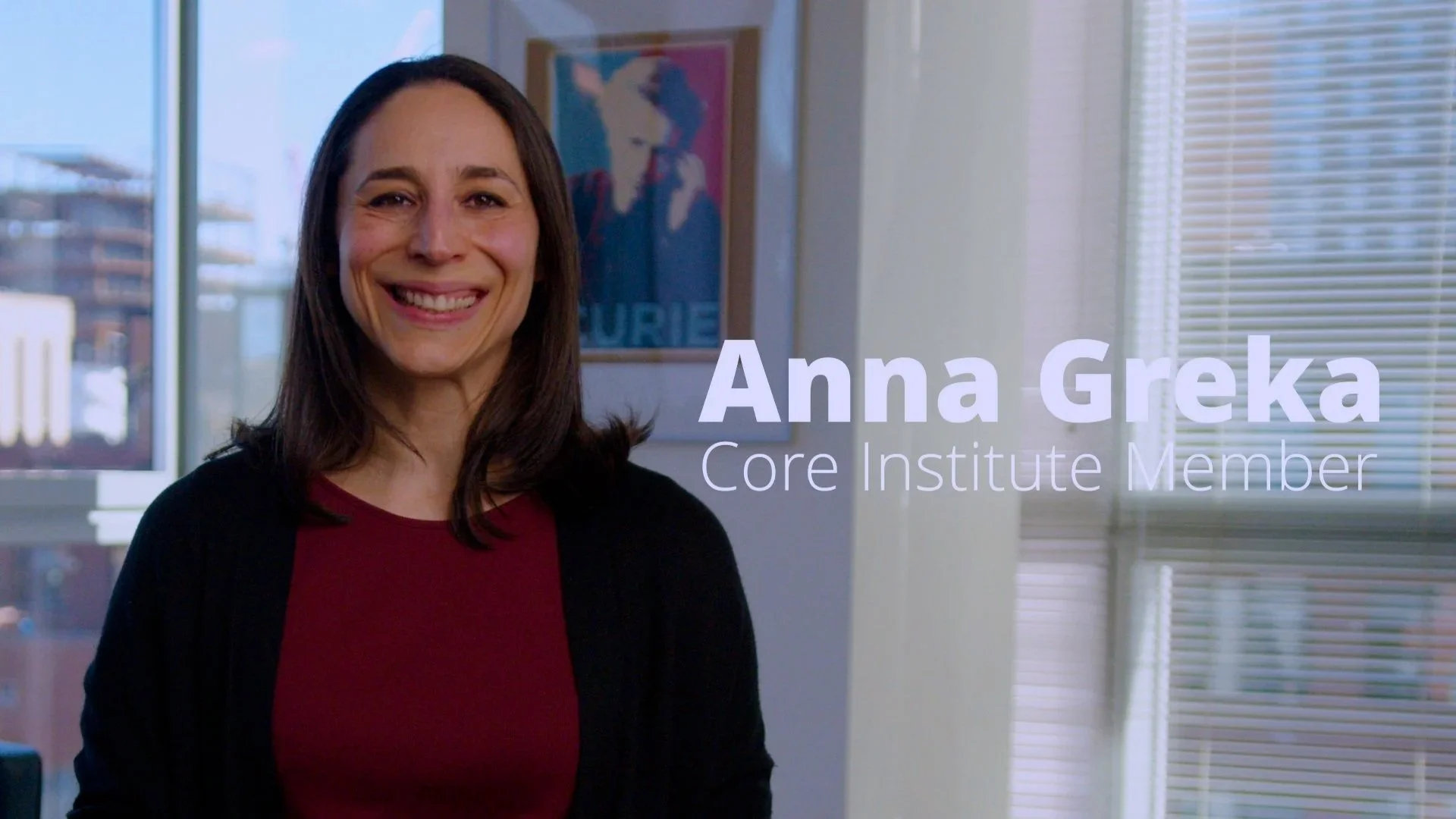
An update from L2C Founder discussing "nodal" biology and the potential to treat multiple genetic diseases with the same drug
Physician scientist Anna Greka, MD, PhD, a core institute member at the Broad Institute and Founder of the Ladders to Cures Accelerator, is on a mission to find and cure genetic diseases that collectively impact millions of people in the U.S. Shared drug targets, called "nodes," underlie many of these genetic disorders. Hear from her on how targeting these nodes unlocks the potential to treat multiple genetic diseases with the same drug, and how her patients motivate her every day.
Connecting genotype and phenotype in CACNA1A-associated disorders
Mutations in the calcium channel gene CACNA1A are linked to diverse neurological and developmental disorders. This clinical diversity, along with complex protein-level consequences, makes it hard to interpret variants' impacts. Erkin Kurganov, Lei Cui, Nikita Budnik, Jen Pan, and collaborators have now characterized the neuronal activity changes caused by 42 de novo CACNA1A variants in human neurons. They found that all variants but one affected calcium channel function and the excitability of human neurons and, in conjunction with clinical data, correlated variants with distinct clinical outcomes. Their study, published in Science Translational Medicine, should guide the development of new treatments for CACNA1A-associated disorders.
CNBC Cures: Accelerating the Path to Breakthroughs
We are so excited about the launch of CNBC Cures, a new initiative to raise awareness about genetic disease research, a call to action to deliver better treatments for patients worldwide, and a L2C Accelerator partner and collaborator.
Learn more about the inspiration behind CNBC Cures and its mission here.
Happy New Year from L2C!
As we enter into the new year, all of us at Broad’s Ladders to Cures (L2C) Accelerator are proud to look back on a year of meaningful progress toward our mission: accelerating bold, high-impact efforts aimed at developing therapies for the world’s most challenging genetic diseases. This past year, the Ladders to Cures Accelerator grew in scale, expanded its impact, and supported an extraordinary cohort of researchers pushing the boundaries of what is possible. We are looking forward to a productive 2026 filled with new and exciting discoveries!
Read the full L2C end-of-year newsletter here.
Interested in receiving future L2C updates? Subscribe to our mailing list here.
In vivo prime editing rescues alternating hemiplegia of childhood in mice
The Ladders to Cures Accelerator (L2C) at the Broad Institute congratulates Alex Sousa, Markus Terrey, Holt Sakai, David Liu, Cat Lutz and many other talented scientists, who received one of the first L2C accelerator grants to develop prime and base editing strategies that could efficiently correct prevalent ATP1A3 pathogenic variants with minimal off-target editing.
This ground breaking research demonstrates a proof-of-concept precision gene editing therapy for alternating hemiplegia of childhood (AHC), a rare neurodevelopmental disorder typically caused by mutations in the gene ATP1A3.

A View from the Frontier | AI for Science Forum
Siddhartha Mukherjee (Columbia University) leads a conversation with panelists Anna Greka, Anne Vincent-Salomon (Institut Curie), and Dame Janet Thornton (European Bioinformatics Institute) at the AI for Science Forum, hosted by the Royal Society and Google DeepMind.

The World’s Rarest Diseases—And How They Impact Everyone | TED Talk
Anna Greka presents the L2C vision from the TED stage.
Broad Institute Nodal Biology Project featured in AP News
“Dr. Anna Greka said the Broad Institute of MIT and Harvard has launched an effort to look at commonalities behind various conditions — or nodes, which can be likened to branches meeting at a tree trunk. Fixing the nodes with gene therapies or other treatments, rather than particular ‘misspellings’ in DNA responsible for one disorder, could address multiple diseases simultaneously.”
Open Call for First Cohort of L2C Projects
We are proud to announce our first Open Call to the entire L2C ecosystem in search of the first cohort of L2C projects.